
Construction Briefs | 012 - The Case for B2C AI in a B2B Construction World
Hey,
Thanks for coming back. I turned 40 yesterday and it felt different. I found myself looking back, reflecting on my career and how much this industry has provided for me and my family. In that reflection, I can’t help but want something similar for my kids. But I’m not nearly as bullish on their future as I am on my past. Maybe every decade feels this way, but the stakes seem higher now. The decisions we make in the next ten years are going to shape the next fifty.
So as I wrote this article on the challenges of AI adoption while using AI to help me draft an outline, catch errors, do research, and create images, I’m aware of how this looks. Someone all in on integrating AI into their personal workflows while pointing to the potential problems it creates. But here’s the distinction that matters: personal use of AI levels me up. Enterprise adoption of AI potentially removes my agency. That difference is everything.
And it’s why I think the future of human centric AI adoption in construction is B2C, not B2B.
On My Mind
The AI conversation in most industries has become almost entirely about what companies can extract: labor savings, efficiency gains, margin expansion. Almost no one is asking what individuals stand to lose in that equation, or what they might gain if they move first.
At its core, the intent of any technological advancement should be human prosperity. Not just corporate margin expansion or shareholder value, but a genuine increase in an individual's ability to think clearly, make better decisions, and create meaningful leverage in their work and life. But let's be clear about how companies operate. They optimize for stakeholders, and workers are typically a minority stake in that equation. What's kept that arrangement functional, is that companies needed people to generate profit. That created alignment. Workers prospered when companies prospered because labor was essential to the equation. AI threatens to sever that alignment entirely. For the first time in modern history, we're seriously entertaining a technological leap that may allow companies to generate profit without needing to share prosperity at all.
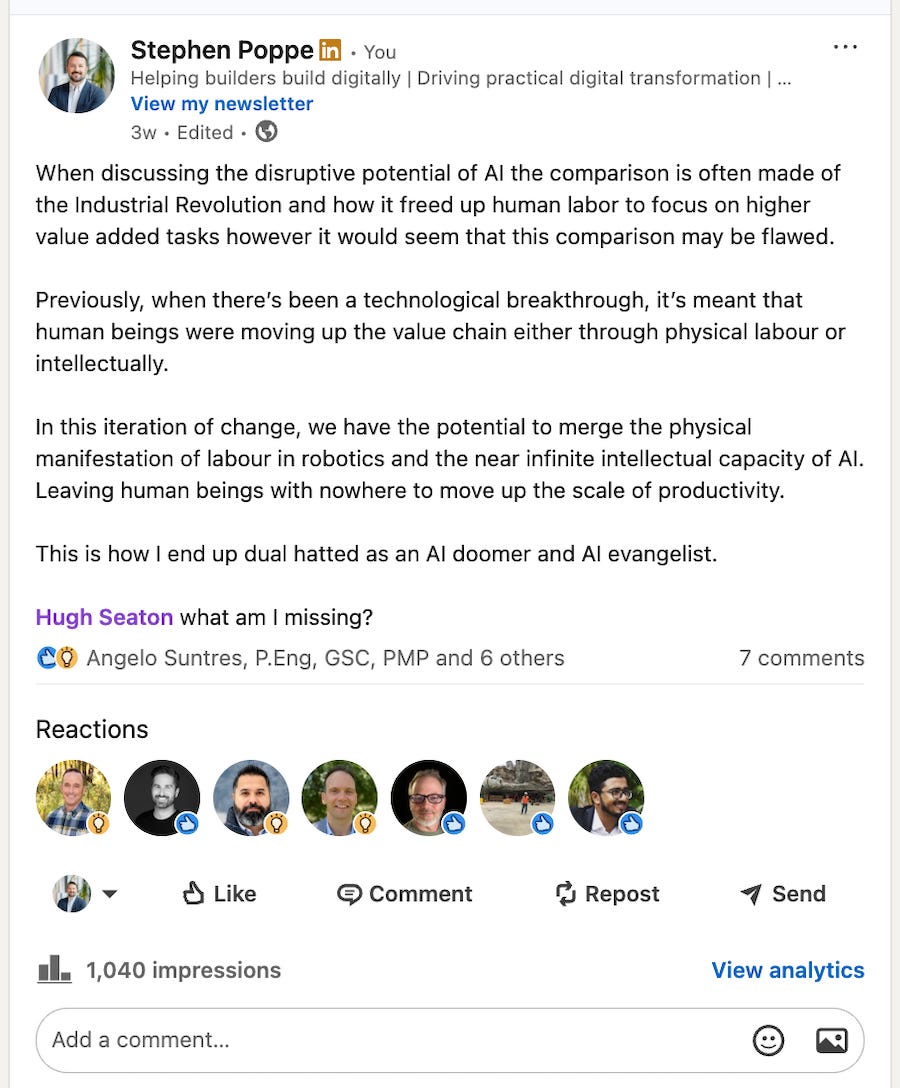
As corporate AI strategies roll out, we’re hearing familiar language. Headcount reductions, labor efficiencies, augmentation. It’s all framed as optimization. But for whom? When the need for human labor, physical or intellectual, drops sharply, the moral calculus inside companies changes. The question quietly shifts from “How do we grow our people?” to “How much longer do we need them?”
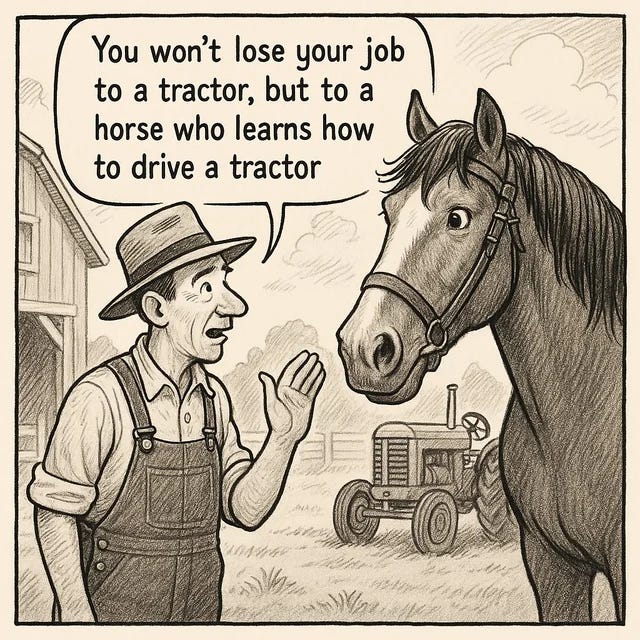
We are already seeing this pattern play out. Intuit openly framed a roughly 10% workforce reduction as part of an “AI-focused reorganization,” pairing transformation rhetoric with immediate headcount reductions. IBM took a quieter path, pausing hiring for entire classes of roles on the premise that AI would eventually do that work. And at Amazon, leadership has been unusually explicit, telling employees to expect a smaller corporate workforce over time as AI agents scale. None of this is accidental. It reveals the incentive shift in plain sight: efficiency becomes fewer people, savings get reallocated to AI infrastructure and a narrow band of high-comp roles, and the average worker is left with thinner career paths, weaker bargaining power, and often more surveillance layered into the job itself. Anyone who believes this story ends at “assistive tools” and doesn’t continue toward full human substitution hasn’t spent much time with incentive structures.
Construction is relatively insulated. Our industry’s messy workflows, siloed data, undocumented best practices, and deeply physical realities slow widespread automation. Ironically, the very inefficiencies we’ve complained about for decades now serve as friction against our own disruption. But friction is not immunity. Those legacy silos only buy time and as a dad with kids ranging from one to eight years old, I’m not interested in romanticizing a future where agency is stripped away and replaced with a monthly check and a polite suggestion to stay out of the way. Human dignity has always been tied to contribution, responsibility, and growth. No amount of technological progress changes that.
The White Space
This is where it gets less gloomy and the opportunity begins to crystallize.
If enterprise AI (e.g. B2B) is optimized around protecting systems, margins, and IP, then the counterweight lives with the individual. With the people doing the work, making the decisions, carrying the responsibility when things go sideways.
Construction tech has spent the last decade selling up the org chart. CIOs. Innovation teams. Digital transformation committees. The pitch is always the same: standardization, increased risk management, visibility, control. Those systems are designed to make organizations more efficient. But there is a parallel opportunity happening beneath that layer, and it belongs to individuals who want to define their own trajectory.
While companies experiment with enterprise AI strategies, individuals can use the same underlying technologies to amplify judgment, accelerate learning, and build capabilities that weren’t accessible before. To level themselves up faster than organizations can formalize the playbook. To decide what kind of professional they want to become and define the future of the industry in which they operate.
We’re already seeing the early signals. Individual professionals are using general-purpose AI tools to write clearer emails, prep meetings faster, summarize chaos into something actionable, and offload the cognitive junk that clogs their day. Not because a committee told them to, but because it makes their lives easier.
But here’s what the next evolution could look like if we build it right.
Think of your expertise not as something locked in your head or scattered across old project files, but as a queryable system. A digital representation of your judgment that captures how you think, not just what you know. Every decision you make on a project, every tradeoff you navigate, every lesson you learn from a mistake feeds into it. Over time, it becomes a living asset that represents your professional capabilities under complexity.
Now imagine this: A healthcare project in Phoenix hits problems. A new PM gets brought in midstream because their experience matches what the site needs. Instead of three weeks of painful knowledge transfer, they grant access to their professional knowledge system. Every decision they’ve made on similar hospital builds, every coordination lesson learned, every vendor relationship, every scheduling workaround. That expertise flows into the project’s central intelligence layer immediately. The team can now query it directly. “Based on similar projects, what are the top MEP coordination risks we should address in preconstruction?” The system answers with specificity because it’s drawing from real experience, not generic best practices and is paired with a real person driving implementation and execution.

But here’s what makes this different from traditional knowledge management: the PM owns that system. It’s portable. When they move companies, it moves with them. It’s not extracted and locked in someone else’s database. It’s licensed. The project pays for access while the PM is contributing. The PM builds equity in their own expertise that compounds over time, creating commercial value beyond their physical presence on site. They’re not just trading hours for dollars anymore. They’re building an asset.
This isn’t science fiction. The underlying technology exists today. What’s missing is the architecture that protects individual ownership and creates fair compensation for distributed expertise. Does the future have to look exactly like this? No, but the point is building technologies that enable the individual to lean into their craftsmanship while simultaneously creating leverage in the marketplace of ideas. If B2C construction tech moves fast and establishes that these systems are individually owned and commercially valuable, we have a shot at a future where human expertise compounds rather than gets extracted.
This is the mistake the construction tech ecosystem risks making: assuming that AI adoption should flow top-down the same way ERP and PM software did. Even if it can and will, should it is the better question. If the goal of technological advancement is human flourishing, then I would argue it shouldn’t.
Closing
None of this is an argument against AI. It’s a recognition of how incentives work.
Enterprise AI will continue to optimize for systems, margins, and scale. Over time, those systems will get cleaner, more controlled, and less tolerant of variance. The room for individual agency inside them will narrow. Not out of malice, but out of efficiency.
Which means the counterweight has to come from individuals willing to take responsibility for their own leverage while they still can. The rational response isn’t to reject these tools or wait for permission. It’s to use them deliberately. The risk isn’t in using AI. It’s in handing over your brain and letting it think for you. That leads to dependency, not leverage. What matters is creating a feedback loop where AI sharpens your thinking instead of replacing it.
Construction tech companies have an opportunity here. To lean into what makes this industry fundamentally human. To build tools that amplify judgment instead of replacing it. To create leverage for the people carrying the responsibility, making the calls, and living with the consequences when things go sideways. But if the industry won’t build it, individuals should. The tools to build your own solutions exist right now. Platforms like Lovable, Cursor, Replit, and others have lowered the barrier to the point where PMs and supers can prototype the exact tools they need without waiting for a tech company to figure it out. Either way, the companies that prioritize the enablement individual capability over enterprise control will inherently attract and keep the best talent.
There is a short window where individual leverage still compounds, before policies show up and tools get standardized, monitored, and locked down. The tools are here, the guardrails are not. That gap won't last forever.
You can use this moment to raise your ceiling, sharpen your thinking, and become more capable in ways that compound. Or you can wait for the policies and approved workflows to arrive and define the limits for you.
AI won’t decide which path we take. Incentives will. And the only real move available has always been the same: claim agency early, and carry it forward before someone else decides you no longer need it.

Subscribe to the Construction Briefs Newsletter so you don’t miss an issue.
See you in a few weeks.