
Construction Briefs | 017 - After the Platform: What Construction Tech Becomes Next
AI, NotebookLM, and the deliverable-agnostic future of project software
Hey,
Welcome to this weeks Construction Brief.
I was able to attend ENR Futuretech in San Fransisco this last week and thoughts on SF aside, the conference was like every other conference in that its main value was in its people and not its content, exhibit halls or anything else. It got me thinking that conferences are destined to go through some fundamental transformation for them to remain relevant.
Side note: If I was small but emerging tech company in construction right now I would start a yearly “Anti-Conference”, invite only to my top customers and curate a series of talks and dinners where challenges and opportunities in the workflows where my product lives would be discussed. The event would be private but the output would public, in that each of the sessions transcript would feed a report out on that challenge or workflow opportunity.
Or maybe even something like this:

The old ways of marketing seems increasingly less relevant and conferences continue to reiterate this truth and even inspired a new blog series called Down to the Studs, where I jot notes down on marketing and go to market strategies to help Contech companies avoid wasting their budgets on things the industry is ignoring.
Conferences in theory should be a great forum for information transfer but what if that happened organically on our project powered by the tools and tech that once promised us the right information at the right time to the right person? What happened to that dream?
On My Mind - 20 Years of Digital Transformation and All We Got are Fancy PDF’s…
Somewhere in the digital transformation of the jobsite over the last two decades, we lost sight of how our brains actually work. Instead of technology enabling more efficient consumption of information based on preferences, phase of work, type of trade, etc, the momentum of digitization stopped the moment physical documents became zeros and ones. The 1,500-page spec is now available on seven different digital platforms, but there is a good chance the concrete contractor has not reviewed any of them and is going to fall back on past experience to navigate the testing requirements, regardless of how flawed their previous experience might be. The model is fully coordinated, but if three specialty contractors do not have Navisworks and could not navigate a model to save their lives, there is a disconnect in the middle of the game of telephone, and the disconnect is the part that costs money.
The instinct is to blame the recipient: if only the foremen would open the model, if only the specialty contractor would log in, if only the field guys would read the spec. We have spent twenty years assuming the consumer of information was the problem and the format was fine. Read any McKinsey article about the industry and you’ll pick up on this narrative that we are a bunch of knuckle draggers in need of more tech…here, here and and even Harvard jumped in on the fun here.
The format was the problem. We just could not fix it.
For most of construction’s digital era, the deliverable dictated the experience because translation was expensive. The geotech report either got read cover to cover or got handed to a junior engineer with instructions to summarize the parts that mattered. The schedule in P6 either got navigated by someone fluent in the tool or got reduced to a stack of printed Gantt charts in a meeting and taped to ever wall in the trailer. The cost of moving information from one form to another was high enough that whoever produced it got to set the terms.
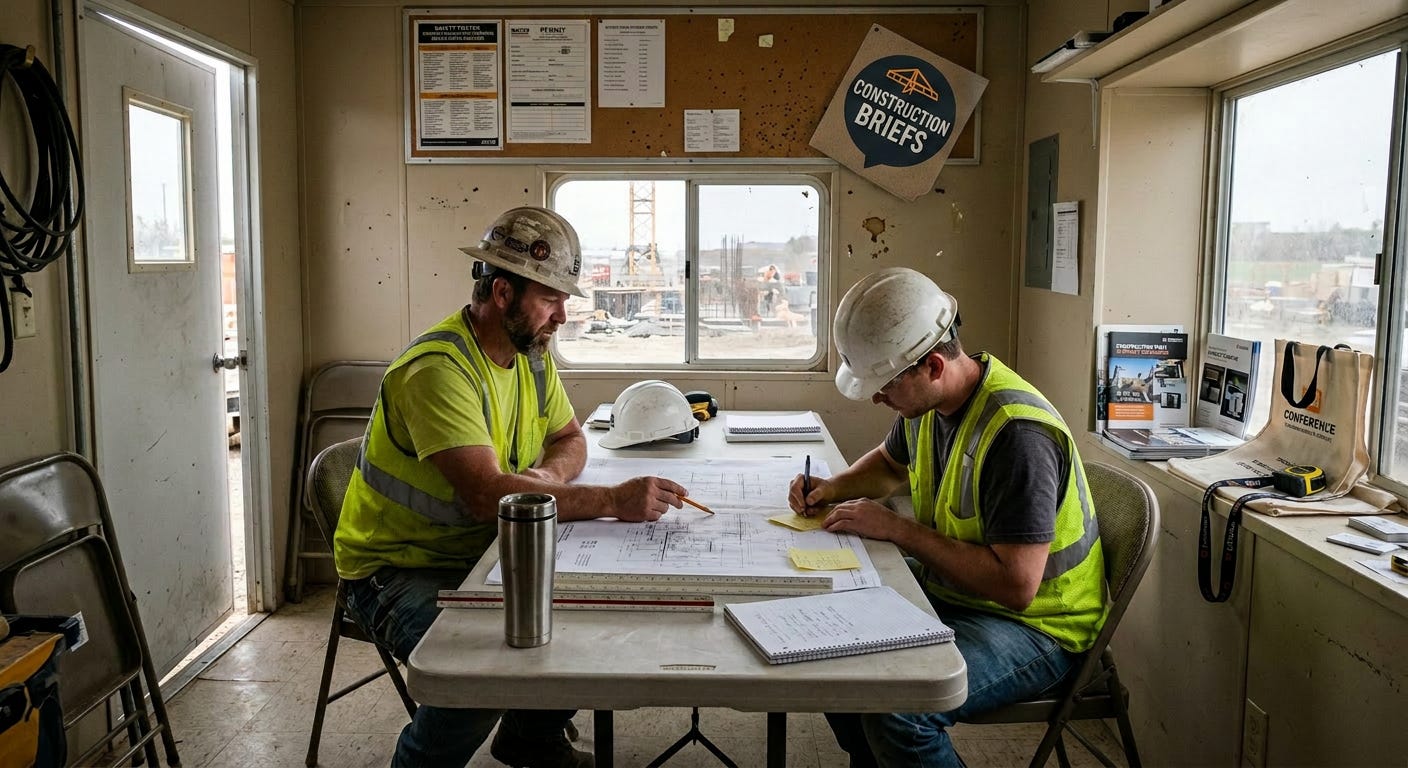
That economic constraint is gone. AI does not care what format the source is in, and it does not care what format the output is in. You can feed it a model, a spec book, a YouTube site walk, and a thread of emails, and it will hand back whatever the human in front of it actually needs, whether that is an audio summary on the drive home, a mind map for the design review, a punch list for the super, or a 90-second video recap for the owner on the status of commissioning. To be clear this technology exists now and is packaged well by Google’s Notebook LM which is our tech to watch later in this newsletter.
The user is now in charge of the interface, not the producer. Which is going to feel deeply uncomfortable for an industry that has spent two decades selling screens.
Most construction tech still leads with its dashboard or it’s UI. Look at our 3D viewer. Look at our chat module. Look at our portfolio analytics. None of those are the product. They are interface choices someone made on the user’s behalf, often badly, and the assumption baked into the choice is that this is how the user wants to consume the answer. The interface is downstream of the data now. What survives is whatever holds the underlying source of truth. What gets compressed into nothing is whatever sits between the data and the human.
Which means the standardization conversation moved. We have been arguing about whether everyone should use the same project management platform, the same document management tool, the same reporting module. That is a 2018 question. The 2026 question is whether the underlying data is clean enough that any interface, including the ones nobody has built yet, can deliver it intelligibly to whoever needs it.
Picture this applied to a real project. A new project manager joins on Monday, opens the project platform, and is offered the same kind of menu NotebookLM puts in front of you when you open a notebook.
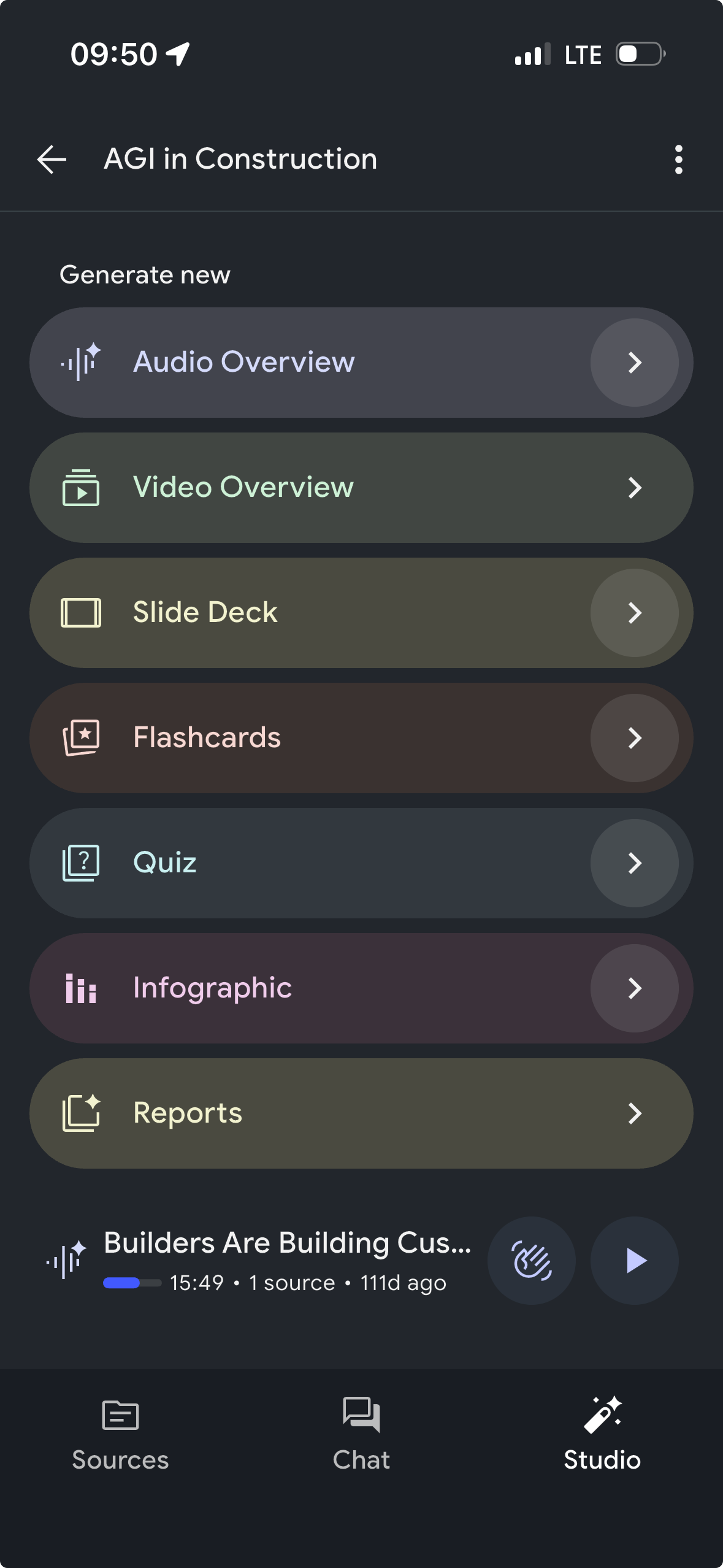
Audio Overview of the project for the drive in. Video Overview of the current schedule status. Slide Deck overview of everything discussed in the previous OAC meetings. Flashcards on the names of critical equipement. Quiz to pressure-test what they actually retained about the contract. Infographic of where the budget sits versus where it was supposed to sit. Each artifact built on the same underlying body of project data, each one rendered in the format that fits the next hour of their day. By Friday they are up to speed in a way that previously took a month of catching up on documents nobody designed to be read.
That is the version of construction technology that wins the next decade, and right now it is not being built by the incumbents. Every dashboard vendor in this industry has a chance to become artifact-agnostic, to stop selling its UI and start selling its access to project data through whatever interface the user picks today. Most of them will not take that chance, because their UI is the only thing they actually own, and in many cases the underlying data is not theirs to sell in the first place.
Which means the data ownership conversation in this industry is being had backwards. Most of the data on a project is not anyone's IP, and worse, most of it has not even been digitized yet. Regional understanding of what certain temperatures will do to curing concrete at different times of year, the PM's read on which framer in town can hold a tight schedule and which one will quietly stretch one job into two, the senior estimator's gut on which subs will carry an unclear detail at no cost and which ones will turn it into a six-figure change order, none of it is sitting in a platform anywhere.
Which leaves the door wide open. Someone is going to build the thing that captures all of that, then layers the NotebookLM for construction projects on top of it, the persistent layer that ingests the model, the spec, the schedule, the RFIs, the meeting transcripts, the daily reports, the photo logs, and the conversations that never made it into a system in the first place, then serves any of it back in the artifact the user actually wants. When that platform shows up, the question for every existing vendor is going to be whether their data was clean enough to plug into the new layer, or trapped inside an interface nobody wanted to begin with.
Tech to Watch - NotebookLM
What it is
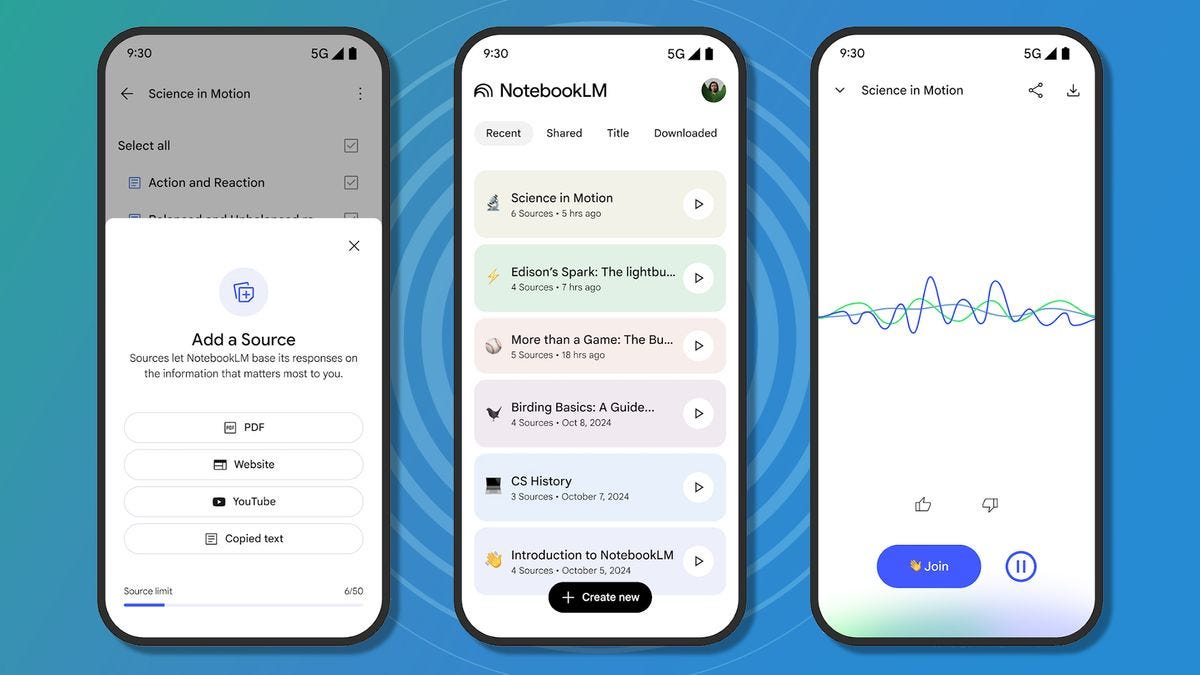
NotebookLM is Google’s AI research assistant. Upload your sources (PDFs, EPUBs, websites, YouTube videos, slides), and it produces summaries on demand in whatever format you want, including a podcast-style audio discussion between two AI hosts, a cinematic video overview with visuals pulled from your documents, a mind map, a written report, or one of ten infographic styles. You can ask follow-up questions, and you can now interrupt the audio hosts with your own voice to redirect the conversation.
Why it matters
Construction generates more long-form content than anyone consumes as we have been discussing. Specs, RFIs in bulk, addenda, O&M manuals, handover binders, geotech reports, ASHRAE references, and a long tail of permit narratives nobody opens. NotebookLM does not replace any of that source material. It lets the same source land in whatever interface the consumer actually has time for. A super listens to the addendum on the drive in. An owner watches a four-minute video summary of a quarterly project review. A new PM walks the existing model with a mind map of the design intent up on a second screen. The deliverable stops dictating the experience.
Who it’s for
PMs onboarding mid-stream. Estimators working through an addendum stack the night before bid day. VDC leads briefing a new project team to a model they did not author. Anyone whose job involves making sense of a body of source material their colleagues do not have time to read.
Check it out
Construction Conversations | Insights - Why KP Reddy Stopped Investing in SaaS, and What He's Building Instead.
KP Reddy is a construction technology investor who just did something every founder in the space should pay attention to. He has made one software investment in the last 24 months. Not because he stopped seeing pitches. Because he thinks the model itself is breaking. The conversation we had about why is the most useful diagnostic of where construction tech actually sits in 2026 that I’ve recorded.
Here’s what stood out.
1. Incentive alignment, not technology, is the actual bottleneck.
KP’s reframe of the standard “why is construction so backwards” question is the cleanest I have heard. There is no incentive in the existing business model to use technology to deliver outcomes faster or cheaper. Architects bill on time sheets, which is labor arbitrage. Civil engineers carry hundred-day receivables on developer permits, so submitting to the city becomes a payment milestone, not a progress milestone. GCs supposedly take risk, but change orders exist, which means most of the risk is actually a translation problem they get paid to manage.
“If a contractor used all this tech and AI and could build a building 30 percent cheaper, there’s no incentive to do that.” Every time someone in this industry proposes that we should “just adopt the tool,” they skip the question of who in the value chain benefits from the tool delivering on its promise. Most of the time the answer is nobody, and that is the explanation for two decades of stalled adoption.
2. The owner has no ally.
This was the most useful conceptual frame in the conversation. KP described an industry where every phase passes the project to the next phase like a hot potato, and none of the players is on retainer to the owner from idea to occupancy. Architects used to be that ally, and KP’s argument is that they opted out by losing their grasp on construction execution and energy economics. GCs are not aligned because change orders pay them. Owners’ reps help, but the industry hires them out of the contractor pool, which means they show up with the contractor’s instincts and political baggage.
His solution with Zero RFI is to insert a persistent AI-driven layer that sits with the owner across every phase, doing what no human firm can afford to staff. Whether or not Zero RFI is the answer is a separate question. The diagnosis lands. Most owners build a building every three to five years, and there is nobody whose paycheck depends on the long-term outcome of the project they are funding.
3. Stop selling enterprise. Sell like a porta-potty guy.
This was the most viscerally true thing said in the entire episode, and it should be required reading for any contech founder still building dashboards for the CFO. Construction does not buy enterprise tools. It buys project tools, project by project, the way it buys porta potties. You show up to the site with a box of donuts, you do the demo, you get the PO, you move to the next site. KP’s pushback on enterprise agreements is that they only show up after the fact, and their main effect is to commoditize a product that was actually selling fine on a per-project basis.
“I would rather not do an enterprise agreement and just charge whatever I want to on a project level.” That is not a market access strategy from a 2018 VC playbook. That is a description of how construction actually buys, told plainly. The founders sitting behind a HubSpot dashboard hoping a drip campaign closes a seven-figure deal are exactly the ones KP says should “get out of the business.” He is not being cruel. He is telling them that the buying motion in this industry has not changed, and pretending otherwise is the actual cause of the cash burn.
4. BIM is dead because it’s just tables.
This is the line most people will quote out of context, so let me give it the right context. KP’s argument is not that 3D models are useless. He is happy to acknowledge that visualization is genuinely useful. His argument is that the tool itself, Revit, has become an interface choice that only the people inside Revit love, while every consumer of model data, whether owner, facilities manager, or super, just wants the answer.
I pushed him on a facilities use case. A remote owner navigating a model to check whether new equipment will fit in a mechanical room. His comeback was the right one. “I message back to my AI saying, hey, this piece of equipment’s coming in next week. Go ahead and run an analysis to see whether that piece of equipment can come through, and send me a screenshot demonstrating the egress of that equipment and what the issues are. That’s what I really want to know.” The model survives, because the underlying data is the value. The screen-and-keyboard interface around the model probably does not. I am still chewing on this one. It is the most direct challenge to my own commercial bias I have heard from a guest, and the fact that he might be right is the part I have been sitting with.
5. The “future state” of AI is already the today state.
This is the part founders should sit with longest. KP described a CRM he built called God’s Eye that builds dossiers on individuals from public information, pushes them to Notion, and surfaces conversation starters before a conference. Eight weeks ago that example would have been a futurist demo. Today it is an afternoon’s work in Claude Code with a few MCP servers running on a laptop.
“It’s not future state. It’s a today state.” The implication is that the moat for SaaS in construction is collapsing not because SaaS itself is dead, but because the interface layer that most SaaS sells is now something a motivated user can build for themselves in a week. KP’s test for what survives is simple: name a SaaS your users actually love rather than tolerate. The companies that pass that test, or the ones that own the underlying data layer everyone else’s interfaces sit on top of, are the ones that come out the other side of this. Foundation Zero is his bet. Whether the bet pays off is open. The framing is correct.
Conclusion
The throughline of the conversation is that construction tech keeps trying to sell its way out of an incentive problem, and the next decade is going to be brutal for any company that built its product on the assumption that the screen is the destination. The screen was always a temporary translation layer. Now it is not even that. KP’s $13.8M seed for Zero RFI is a bet that the layer below the screen, the one that ingests every source on the project and serves the answer to whatever interface the user happens to be holding, is where the value moves next. Founders building anything else should at least be able to articulate why their company survives the move.
Best Quotes
“If a contractor used all this tech and AI and could build a building 30 percent cheaper, there’s no incentive to do that.”
“Submitting to the city is a payment milestone, not a work progress milestone.”
“I would rather not do an enterprise agreement and just charge whatever I want to on a project level.”
“The only people that love Revit are the people that are on the computer using Revit. They love it. Nobody else loves it.”
“I have made one software investment in the last 24 months.”
“It’s not some kind of future state. It’s a today state.”
See you all in a couple of weeks.
- Stephen